
Remembering Catalan Clown Claret Papiol
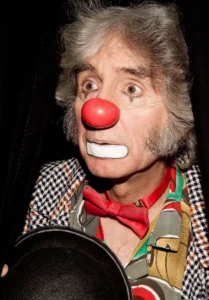 A video was posted today on Instagram, marking the one year anniversary of the passing of Claret Papiol. The name sounded vaguely familiar, and when I looked him up I discovered that he was one of the master clowns of Catalonia. I didnt know him at all, but had heard of him, but somehow I had missed the news of his death, despite the fact that I live in Catalonia, and I like to think I am connected at least somewhat to the clowning community here.
In honor of Claret Papiol, I have synthesized a couple of his obituaries and other writings about him to create this remembrance of him in English. I wish I had written about him when he was alive.
 Antoni Maria Claret Papiol was born in Barcelona in 1954. Claret came of age in a country where public expression had been suppressed for decades. Franco kept a tight rein on comedic expression and dissidence, and also actively tried to push down local and independent voices. When Franco passed away in 1975, that political upheaval created space for artists to do things differently. In 1976, Claret co-founded the duo Germans Roscón with Tortell Poltrona, declaring with pride that they were among the first clowns to perform in Catalan, doing so in service of the normalization of humor in their country. That wasn’t a small act. It was a cultural statement — comedy as resistance, laughter as reclamation.
Here’s the video I saw, posted by barcelonacirco.
He co-founded Germans Poltrona alongside the legendary Tortell Poltrona, deepening his connection to the heart of Catalan circus culture. He collaborated with Titelles Marduix, La Claca, and the iconic Circ Cric, and in 1988 he founded his own company, Claret Clown, through which he leaned heavily into theatrical clowning, including shows Ipso Flauto, I’m a Clown, Devos to You, and KOLO 1714. He was very skilled with wordplay and improvisation and was able to connect strongly to the audience as he performed.
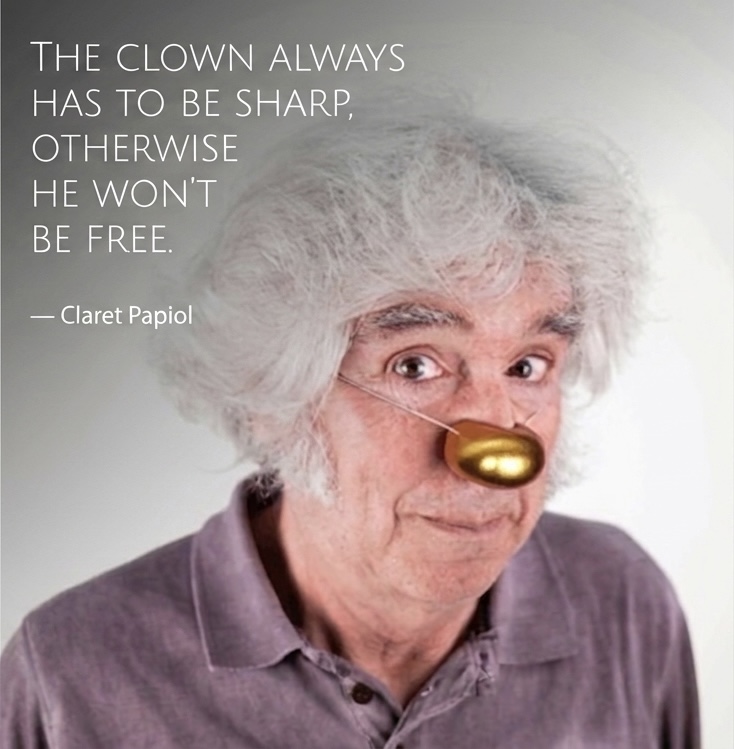 He had a couple of great quotes that were reflected in his work:
“The clown always has to be sharp, otherwise he won’t be free.¨
“Art and culture must be protected because they are what can provide an external view of society.”
He is quite well known to Catalan audiences for a television show he was on called El Capità Enciam (Captain Lettuce) in the 1990s. It was a series of 5 minute episodes about environmental awareness. His character Blay Brossa (Brossa translates to Trash) would make an environmental faux pas, and Captain Lettuce would come in to save the day. Captain Lettuce’s catch phrase was “Els petits canvis són poderosos” (“Small changes are powerful”). Papiol’s performance as the bumbling Blay Brisas was vital in cementing this environmental message into the cultural consciousness of the community.
Here’s a sample of El Capita Enciam. Papiol plays the litterbug father. It’s in Catalan, but the gist is easy to understand. It was produced in the 1990s, and the style shows clearly.
He wasn’t only a performer, he was also a teacher and community builder as well. He taught clowning at a number of drama schools and art schools in Barcelona and Girona, passing his craft and expertise on to generations of performers who have continued to perform and create original works. I did not study with him, but some of what I read about his teaching stylesays that he emphasized word play and absurdity more than physical comedy, more Monty Python than Three Stooges. He believed strongly in the white clown-contra auguste dynamic, white clown representing order, and the auguste/contra auguste representing rebellion and chaos. He also focused on radical vulnerability, encouraging his students to embrace their flaws and fears as their strengths that would allow them to find subject matter and comedy within.

Over the course of his career he received prizes including the Sabatot Alegre, the FAD Sebastià Gasch award, and two Zirkòlika awards. In 2018, he was honored with the Golden Nose at the International Festival of Clowns in Cornellà, and in 2023, the Zirkòlika circus awards gave him a lifetime achievement prize.
I never met him while he was alive, but he definitely sounds like a guy who knew his craft, made a difference, and believed in the power of the clown to change society. All of which make me regret NOT knowing him.
Rest in peace, Claret.
Gràcies.