
Clownvergence 2026 – April 9-12, 2026
 The second annual online summit for Clowns, Clownvergence, is nearly upon us. Clownvergence 2026, will run from Thursday April 9 through Sunday, April 12.
It will be chockful of clowns as hundreds of clowns of all types- circus performers, theatrical comedians hospital clowns, activist provocateurs, pedagogues, and red nose fans will convene for three days to share tips, tricks, discussions, secrets, and best practices.
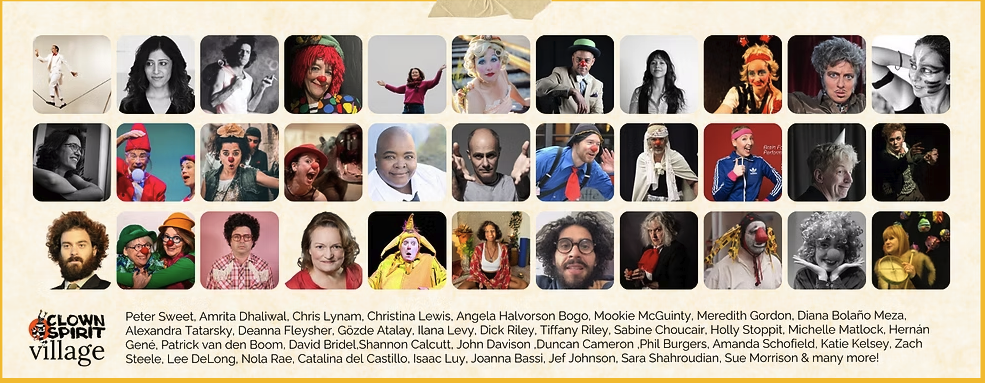
Some of the many people who will be at Clownvergence 2026
For those unfamiliar, Clownvergence is not a variety show (although it does contain a couple of performances within its borders). This is more of a professional and artistic symposium- a space where the question “what is clown for?” gets asked seriously, playfully, and from every possible angle. Over the course of three days, participants will move between workshops, panels, provocations, whole-group energisers, and open Clown Café sessions designed for integration and spontaneous conversation. The format is generous: multiple parallel tracks run simultaneously, meaning there is always more to discover than any one person can attend. Many of the sessions will be recorded, and made available to participants afterwards, in case they were unable to attend.
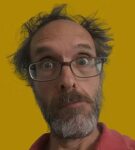
Barnaby King
Clownvergence is put on by Clownspirit Village a community run by clown, activist, and fellow Clown Influencer Barnaby King.
Barnaby is a performer, scholar and teacher, with a special interest in clown, humor, and popular performance and their relationships to social, economic, and political realities. His PhD, completed in 2013 at Northwestern University, revolved around clowning in Colombia as a transformative social practice. Barnaby founded Clownspirit Village in 2021.
If you would like to sign up for Clownvergence, Register here.
Why Clownvergence Matters
The 2026 programme makes visible just how wide the field has become: although the traditional view is perhaps clown as simply a family entertainer, there are so many other ways that people use clowning in today’s world. Clown as a therapeutic modality, clown as political resistance, clown as environmental activism, clown as intercultural bridge, clown as somatic practice. And yes, clown as entertainer as well. Each of these streams carries its own methodology, its own ethical questions, its own relationship to the body, to failure, and to the audience. Clownvergence is the only event that holds them all in the same room — or in the case of Clownvergence the same digital space — and allows them to cross-pollinate.
As well, the fair pricing model of the event allows ANYONE to participate regardless of economic status. Those who can, pay more. And those who can’t pay less. It’s a really interesting sliding scale model (The Green Bottle Method) that was formulated by Alexis J. Cunningfolk. Find out more about the model here.
Three Days, Three Arcs
Clownvergence 2026 Day 0 Thursday April 9
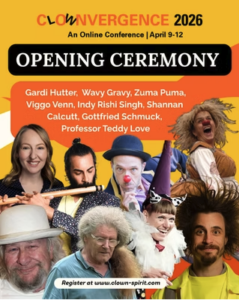
On Thursday April 9 (Day 0) there will be an opening ceremony and other events 9am – 12.30pm EST
The opening ceremonies will set the tone for the event, with international appearances by Gardi Hutter, Viggo Venn, Shannon Calcutt, Indy Rishi Singh, Zuma Puma, and even one by the original 1960’s activist clown Wavy Gravy. (My favorite story about Wavy Gravy is that he ran for office in Berkeley against the incumbent, a staunch Republican. His poster was him in his full clown regalia, and at the bottom a note that said something like “Wavy Gravy has a long history of fighting for what he believes in. We doubt his opponent has even been to jail once!”
Clownvergence 2026 Day 1 — Friday, April 10
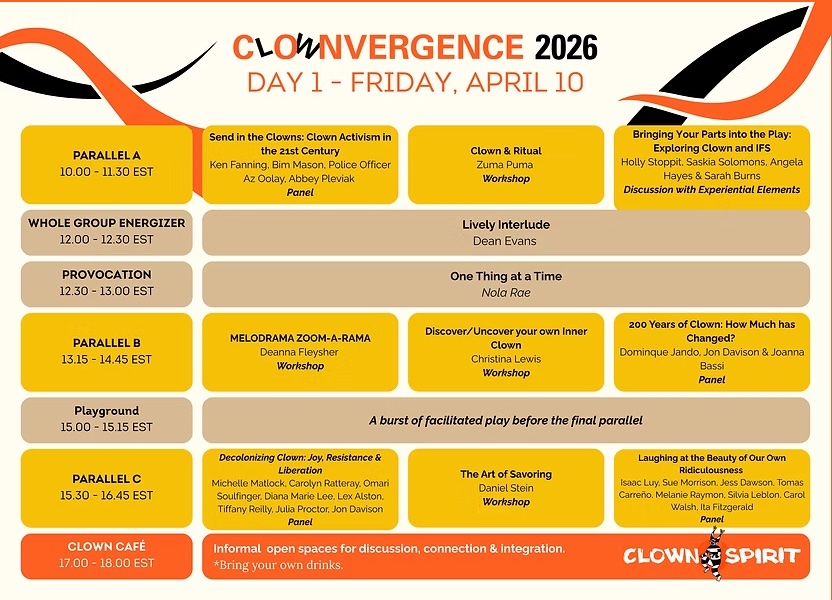 The opening day sets a searching tone. The morning parallel sessions tackle clown at the intersection of politics and spirit. Send in the Clowns: Clown Activism in the 21st Century — a panel featuring Ken Fanning, Bim Mason, Police Officer Az Oolay, and Abbey Pleviak — asks what it means to deploy the red nose in spaces of civic unrest and political theatre. Running alongside it, Zuma Puma’s workshop Clown & Ritual explores the ceremonial and shamanic dimensions of the form, while Bringing Your Parts into the Play: Exploring Clown and IFS brings Internal Family Systems therapy into dialogue with clown practice in a discussion with experiential elements led by Holly Stoppit, Saskia Solomons, Angela Hayes, and Sarah Burns.
After Dean Evans’s whole-group energiser Lively Interlude and a provocation from Nola Rae titled One Thing at a Time, the afternoon opens into the Parallel B and C sessions. Deanna Fleysher brings her celebrated Melodrama Zoom-a-Rama workshop; Christina Lewis guides participants in Discover/Uncover Your Own Inner Clown; and a fascinating panel — 200 Years of Clown: How Much Has Changed? — brings together Dominique Jando, Jon Davison, and Joanna Bassi in what promises to be a spirited historiographical debate. The day closes with three parallel offerings including Michelle Matlock and company’s Decolonizing Clown: Joy, Resistance & Liberation, Daniel Stein’s Art of Savoring workshop, and a large ensemble panel on Laughing at the Beauty of Our Own Ridiculousness.
Clownvergence 2026 Day 2 — Saturday, April 11
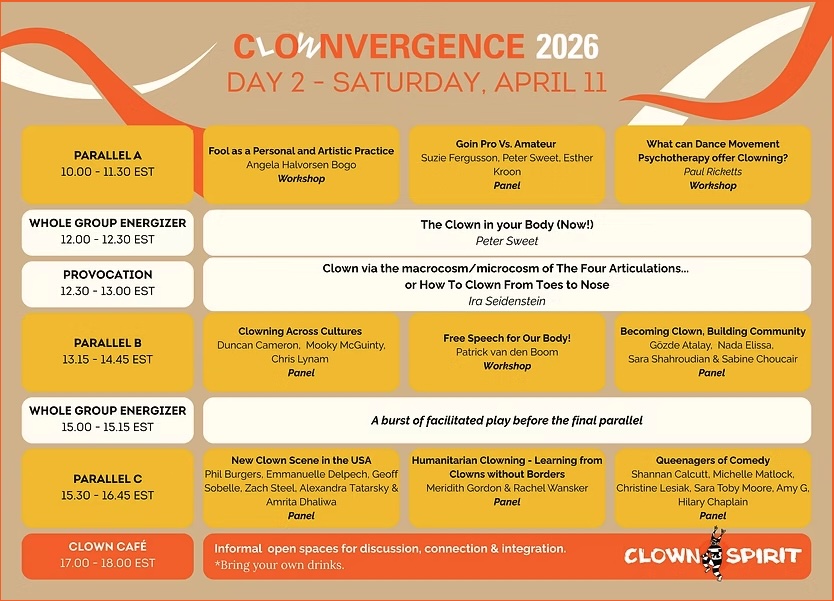
Saturday deepens the inquiry into clown’s social dimensions. The morning features Angela Halvorsen Bogo’s workshop Fool as a Personal and Artistic Practice, a panel on Goin Pro vs Amateur (Suzie Fergusson, Peter Sweet, Esther Kroon), and Paul Ricketts’s fascinating exploration of what Dance Movement Psychotherapy Can Offer Clowning. Peter Sweet then leads the whole group through The Clown in Your Body (Now!), followed by Ira Seidenstein’s provocation on clowning from toes to nose through the lens of the four articulations.
The afternoon’s parallel sessions include a thoughtful panel on Clowning Across Cultures (Duncan Cameron, Mooky McGuinty, Chris Lynam), Patrick van den Boom’s physical Free Speech for Our Body! workshop, and a panel on Becoming Clown, Building Community with Gozde Atalay, Nada Elissa, Sara Shahroudian, and Sabine Choucair. The day closes with three standout panels: New Clown Scene in the USA, Humanitarian Clowning: Learning from Clowns without Borders, and Queenagers of Comedy — a panel on clown, age, and women in comedy featuring Shannan Calcutt, Michelle Matlock, Christine Lesiak, Sara Toby Moore, Amy G., and Hilary Chaplain.
Clownvergence 2026 Day 3 — Sunday, April 12
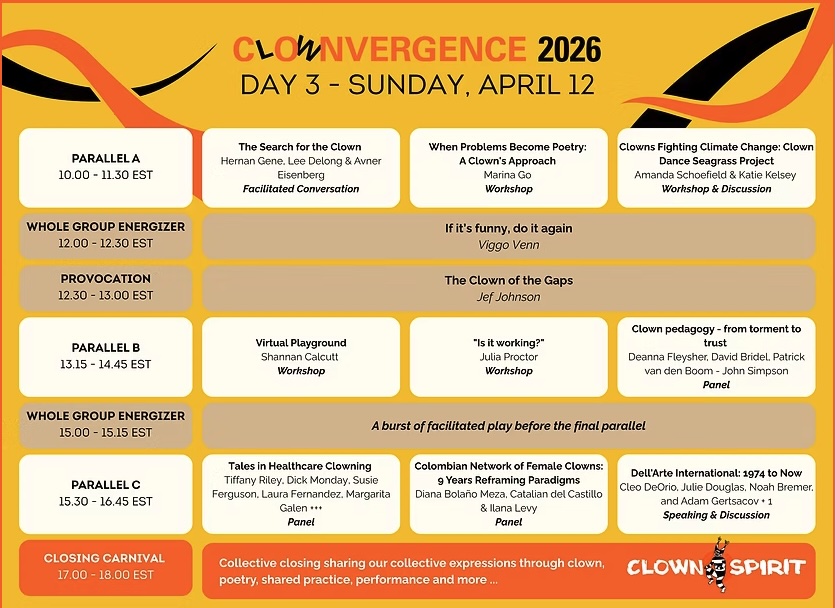
Sunday brings the arc home with sessions that look both inward and outward. The morning parallel block includes Hernan Gene, Lee Delong, and Avner Eisenberg in The Search for the Clown (a facilitated conversation that has become a Clownvergence legend), Marina Go’s workshop When Problems Become Poetry: A Clown’s Approach, and Clowns Fighting Climate Change: Clown Dance Seagrass Project with Amanda Schoefield and Katie Kelsey — a remarkable fusion of environmental science, movement, and clown pedagogy.
After Viggo Venn’s whole-group energiser If It’s Funny, Do It Again and Jef Johnson’s provocation The Clown of the Gaps, the afternoon brings more workshops and panels, including Tales in Healthcare Clowning (Tiffany Riley, Dick Monday, Susie Ferguson, Laura Fernandez, Margarita Galen) and another panel on the Colombian Network of Female Clowns: 9 Years Reframing Paradigms panel with Diana Bolaño Meza, Catalan del Castillo, and Ilana Levy.
The final panel is one that I am going to be sitting on, going through the legacy and future of the Dell’Arte School, of which I am a proud graduate. Also on that panel are Cleo DeOrio, Julie Douglas, Noah Bremer, Artemis Pebdani, & Joe Dieffenbacher.
The whole event closes with a Closing Carnival — a collective celebration through clown, poetry, shared practice, and performance.
The Dell’Arte Legacy
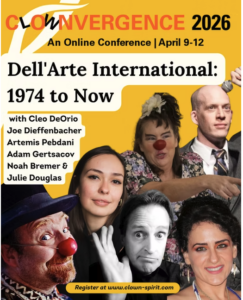 For those less familiar with the Dell’Arte International School of Physical Theatre: founded in Blue Lake, California in 1974, Dell’Arte helped establish a distinctly American tradition of physical performance rooted in commedia dell’arte, mask work, and ensemble devising. Its influence on contemporary clown practice — in the US and internationally — is difficult to overstate. The Sunday panel will explore how that legacy lives in the bodies and practices of working artists today, and what it means to carry a lineage forward while remaining genuinely alive to the present moment.
I hope you can attend the event!
If you would like to sign up for Clownvergence, Register here.